

Introduction
This page covers the topic on what GlobalQuake is and what it exactly does.
What is GlobalQuake?
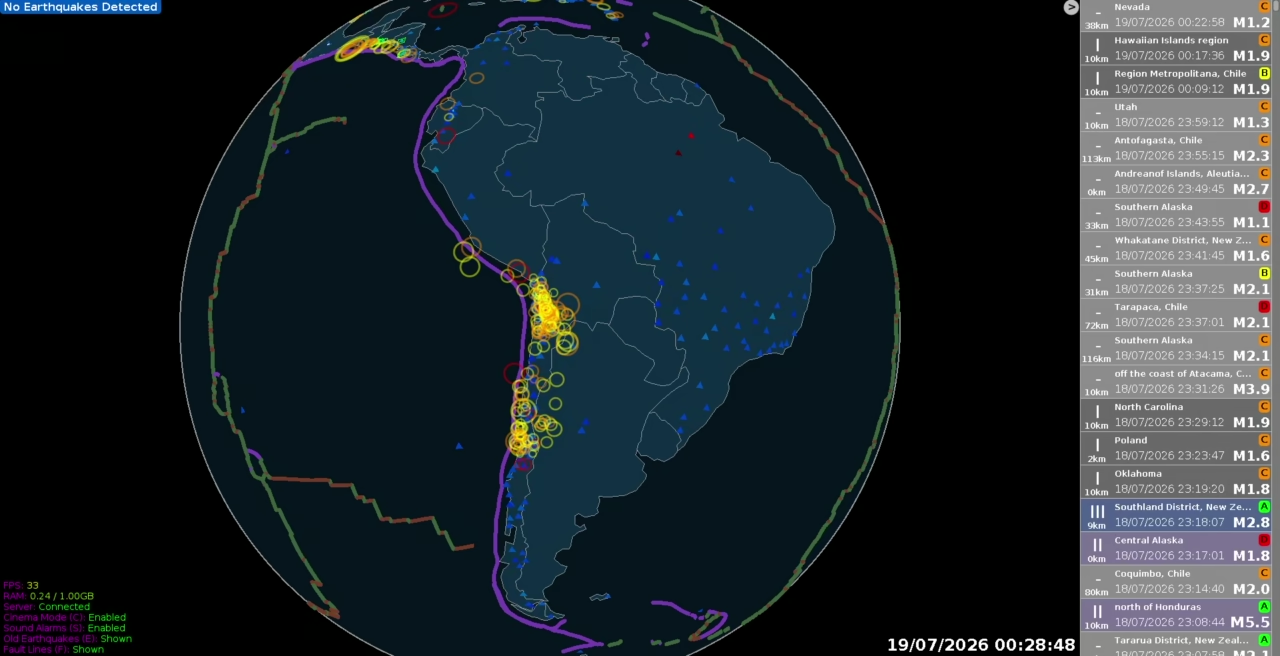
GlobalQuake is an experimental Java application that can be used to monitor earthquakes world-wide in near real time from publicly available seismic networks.
It can also estimate the earthquake magnitude using various numerical estimation methods that are capable of estimating the magnitude reasonably accurately for nearly any earthquake size (most accurate up to M8 though).
GlobalQuake is still very experimental and should only be used for entertainment purposes, as the displayed information can be inaccurate or completely wrong.
Be aware that playing some of the alarm sounds in public could be illegal in certain countries due to fearmongering laws.
How it Works
GlobalQuake uses a client-server architecture to deliver near real-time earthquake data.
- The server connects to seismic servers around the world and receives live waveform data from public networks.
- Automated algorithms continuously analyze incoming station data. When a group of nearby stations detect simultaneous shaking, the system identifies it as an earthquake cluster.
- A hypocenter search then determines the earthquake's origin. Latitude, longitude, depth, and origin time based on the timing of seismic wave arrivals across the cluster.
- Magnitude estimation uses multiple numerical methods to approximate the earthquake's size, working reliably for small to large events (most accurate up to M8).
- Results are sent to connected clients in real-time, where the client renders everything on a 3D interactive globe.
The entire process from data ingestion to visualization happens automatically with no manual intervention required.
What is GlobalQuake good at?
- It can easily select publicly available seismic stations.
- It can visualize detected earthquakes on a 3D global interactive map.
- It can quickly estimate small and moderate earthquake's magnitude, location and depth.
What is GlobalQuake struggling with?
- Larger earthquakes (M8+) often trigger false detections or show duplicated earthquakes.
- Unable to detect multiple earthquakes in the same epicenter in a short period of time.
- Calculation of distant earthquakes from a certain set of stations is always less accurate than a local earthquake.
- Epicenter location during a megathrust event.